Mathematics is everywhere — and at Moranbah Early Learning, July gives us the most wonderful seasonal backdrop for bringing numbers to life. Winter themes, cosy indoor spaces, and the magic of the mid-year season all become rich contexts for mathematical exploration with our young learners.
Why Contextual Maths Matters in Early Childhood
Young children don’t learn mathematics through worksheets and repetition — they learn through play, story, and meaningful context. When we embed number concepts into something children can see, touch, and relate to (like winter weather, warm food, and seasonal animals), abstract ideas become concrete and memorable.
Mathematical learning in the early years lays the groundwork for:
– Number sense and counting fluency
– Understanding quantity, more and less, addition and subtraction
– Pattern recognition — a fundamental mathematical skill
– Spatial reasoning through building and construction
– Problem-solving and logical thinking
– Mathematical language (more, fewer, bigger, smaller, equal)
At Moranbah Early Learning, our educators are skilled at finding mathematics in everyday moments and crafting intentional learning experiences that make numbers genuinely exciting.
Winter-Themed Maths Activities at Moranbah Early Learning
Counting Snowflakes (Paper Snowflake Maths)
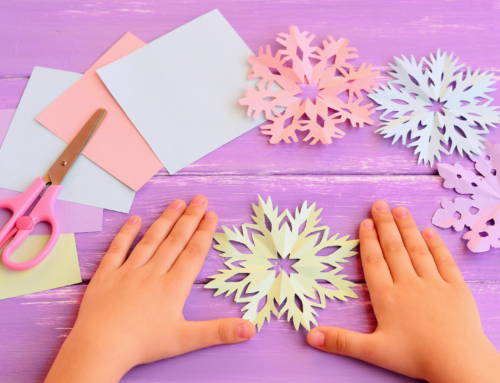
Children create paper snowflakes (a classic winter craft) and use them for counting, sorting, and pattern-making activities. How many points does each snowflake have? Can you sort them by size? Can you make a pattern — big, small, big, small?
Winter Animal Counting Stories
We use picture books and story props featuring winter animals — bears hibernating, birds migrating, frogs burrowing underground — to practise counting, adding, and subtracting. “There were 5 frogs hiding in the mud. Two more arrived. How many frogs now?”
Warm Drink Measurement Activities
Children measure water into cups, jugs, and containers during warm drink preparation — exploring concepts of full, half-full, and empty, and comparing volumes. Pouring and measuring is endlessly satisfying sensory and mathematical play.
Winter Sorting and Classifying
Collections of winter objects — pinecones, smooth stones, fabric scraps, leaves — become sorting and classifying games. Children sort by colour, size, texture, and shape, building early data and classification skills.
Building with Blocks: Counting and Comparing
Our block area becomes a winter construction zone — children build “dens,” “caves,” and “winter shelters” and count how many blocks they used, compare heights, and solve spatial problems. Mathematical language flows naturally through this play.
Temperature Graphing
Using a simple outdoor thermometer, children measure and record the morning temperature each day throughout July and create a simple pictograph. This introduces early data concepts, patterns, and comparison in a genuinely meaningful context.
Number Writing in Salt Trays
Filling trays with salt or fine sand and inviting children to write numbers with their fingers is a perfect multi-sensory winter activity. The tactile experience of tracing numbers supports fine motor development and number formation simultaneously.
Maths Is Everywhere This Winter
We encourage families to look for maths in their everyday winter routines:
– Count the layers of clothing when getting dressed for a cold morning
– Measure and pour when making a warm drink together
– Notice patterns in winter fabric, wallpaper, or nature
– Count items when shopping or unpacking groceries
Mathematics at home doesn’t require special materials — just a curious eye and a willing guide.
Keywords: mathematics early learning, number learning preschool, winter maths activities children, early childhood education Queensland, Moranbah early learning, counting activities preschoolers, maths through play, STEM early years, number sense young children, early learning Moranbah
Sources and Further Reading:
– Raising Children Network – www.raisingchildren.net.au
– Australian Children’s Education & Care Quality Authority (ACECQA) – www.acecqa.gov.au
– Early Childhood Australia – www.earlychildhoodaustralia.org.au
– The Early Years Learning Framework (EYLF) – www.acecqa.gov.au/eylf
– Kidspot Australia – www.kidspot.com.au